From Coachella to Open’er Festival
How the Festival Experience Is Changing in Poland
An Event That Goes Beyond the Event
When we think of Coachella, the first association is still music. The line-up, the headliners, the stage. That’s natural, because that’s how it all began. Today, however, this is just one layer of a much larger phenomenon.
For years, Coachella has functioned as an experience designed from start to finish. Every element matters — from the first digital touchpoint, through the space and stage design, to what stays with the participant after the festival ends. It is precisely this consistency that has made the event a benchmark for the entire industry.
Designing Experience Instead of an Agenda
The biggest shift isn’t about technology or budgets, but about the way of thinking. In many cases, events are still designed around the schedule. Meanwhile, Coachella starts in a completely different place — with the emotions of the participant.
Space stops being a backdrop. It becomes part of the narrative. Art installations, lighting, scenography, and branding create a coherent world in which the participant becomes immersed. That’s why the experience translates so naturally to social media — not as a side effect, but as a consequence of the design.
Content as Part of the Event
Modern events function simultaneously in two worlds: the physical and the digital. Coachella doesn’t treat this as a challenge, but as a starting point.
Content is not an add-on. It is an integral part of the experience. The participant doesn’t just take part in the event — they co-create it, publishing and building a narrative that extends beyond the festival grounds and its duration. For brands, this means a shift in role. Mere presence is no longer enough. What matters is whether the brand becomes part of the story that the participant wants to share further.
Brands as Experience, Not Exposure
At Coachella, brands don’t function as sponsors in the traditional sense. It’s not about visibility, but about presence within the experience.
The best activations don’t feel like advertising. They feel like something the participant wants to live through. This approach is becoming increasingly visible on the Polish market as well.
The Polish Festival Scene Is Accelerating
Just a few years ago, many brands approached festivals in Poland with caution. Today, event production is developing dynamically, and clients are increasingly choosing bolder, more immersive projects.
Festivals are no longer just a space for presence. They are becoming a platform for experiences.
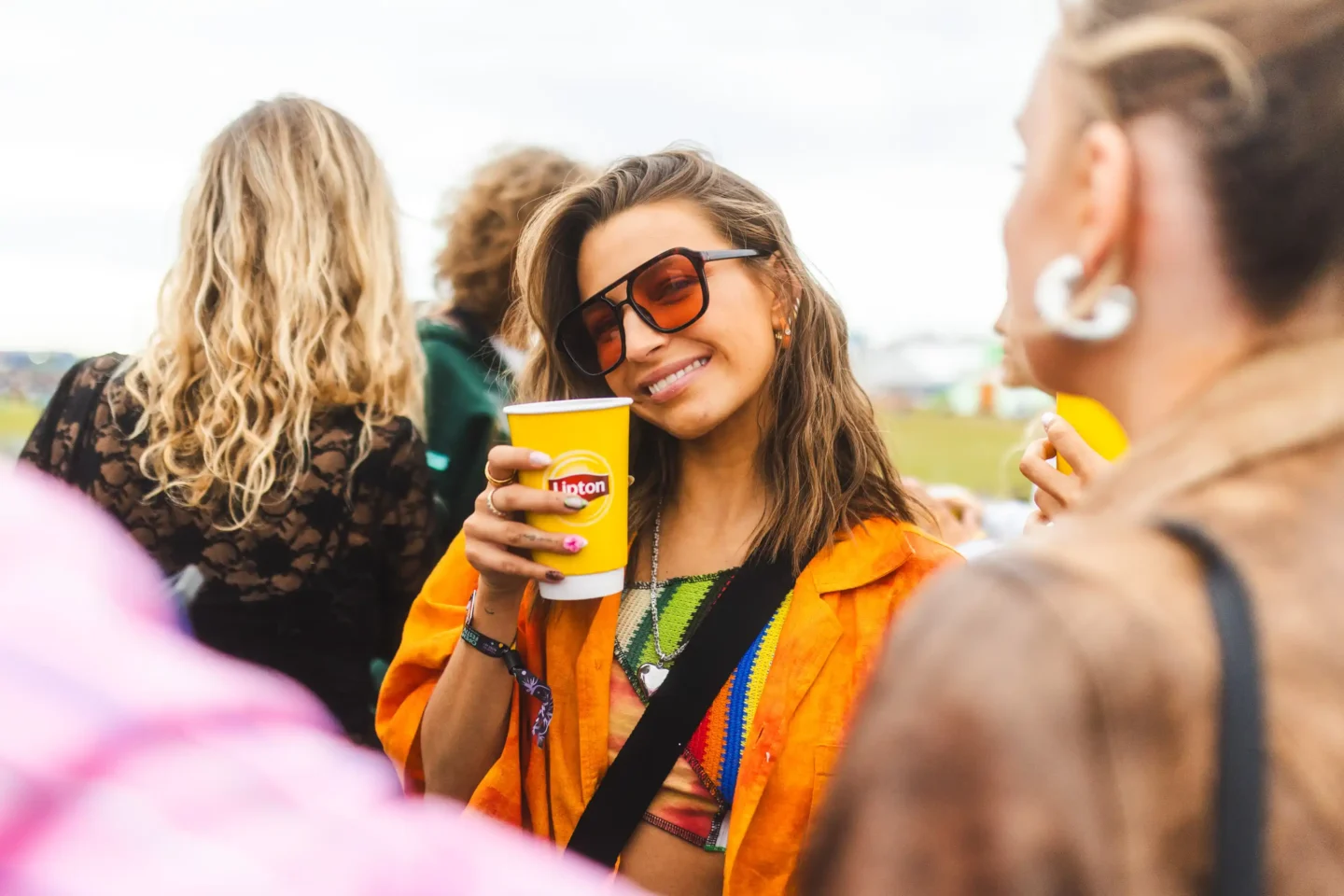
A good example is Warsaw Creatives’ production at Open’er for the Lipton brand. The yellow zone next to the main stage attracted participants not only with its aesthetics, but above all with the relevance of the idea. Hot tea served at night responded to a real need — for regeneration and a moment of breath. It was precisely this fit with the context and the moment that made the experience memorable.
Increasingly, however, such zones are no longer just an addition to the event, but its natural extension — a coherent part of the world the participant moves through.
This is clearly visible in Warsaw Creatives’ production at the Miraż festival for the Belvedere brand. The Belvedere Dreamscape zone was designed not as a separate sponsor space, but as an element of the festival’s narrative. Inspired by the OFF SCRIPT concept and the raw architecture of the venue, it operated through contrast — an industrial structure paired with soft, pink fabrics and silver forms.
Round beds, a ball pit, and swings made of metallic tires built an experience balancing between dream and reality. A parallel VIP area with caviar and a House of 10 selection added an extra layer of sophistication. This is an example of an approach where the brand is not an add-on, but co-creates the world of the event.
Why It Works?
The strength of such projects doesn’t come solely from the budget, but from understanding why the participant comes to the event in the first place. Not to see the brand, but to experience something they will want to remember and share.
This approach changes the role of the event agency — from contractor to partner who designs the entire experience.
The Future of Festival Experiences
The direction is clear. Events will become increasingly immersive, more deeply rooted in experience, and naturally connected to digital.
Event production in Poland is entering a stage where it can quickly catch up with global trends — not by copying Coachella, but by understanding the mechanisms behind it.
Because in the end, it’s not scale that determines the power of an event. What determines it is whether someone will want to remember it.