Managing aesthetics in the age of algorithms
When to implement AI and when to protect your DNA
In a world of “algorithmic homogenization,” authentic art direction is becoming the real luxury. AI should optimize production, but it’s the human eye that guarantees the uniqueness driving genuine brand value.
Is your brand starting to look like all the others?
In the race to optimize costs, many fashion and beauty brands have quietly fallen into a trap. The widespread use of off-the-shelf AI models has blurred the line between premium campaigns and mass-market e-commerce.
Gartner experts call this phenomenon algorithmic homogenization. When an algorithm learns from the “statistical average” of the internet, the end result inevitably gravitates toward an aesthetic middle ground. For a brand, this is a critical situation: when aesthetics become predictable, identity is lost. And this is a tangible threat – according to 2026 forecasts, as many as 72% of luxury consumers will actively look for evidence of a “human touch” in brand communication.
Where do we most often lose control of our image?
The biggest mistake isn’t the technology itself, but handing over the wheel without creative oversight. Treating AI as a “cheap replacement” results in images that are technically correct but completely stripped of emotion.
Another issue is failing to distinguish between mass asset production and the creation of so-called hero content. While AI excels at scaling content for social media, the imagery that builds brand positioning requires craft – the chemistry between people on set, or the unique “imperfections” of light that algorithms (so far) can’t convincingly replicate.
How does AI shorten the distance between idea and shoot?
At Warsaw Creatives, we don’t see AI as a generator of ready-made concepts. We treat it more like modern, digital scissors – a tool that lets us quickly cut away the unnecessary and prototype visions that previously took weeks of work.
Our approach is built on three paths:
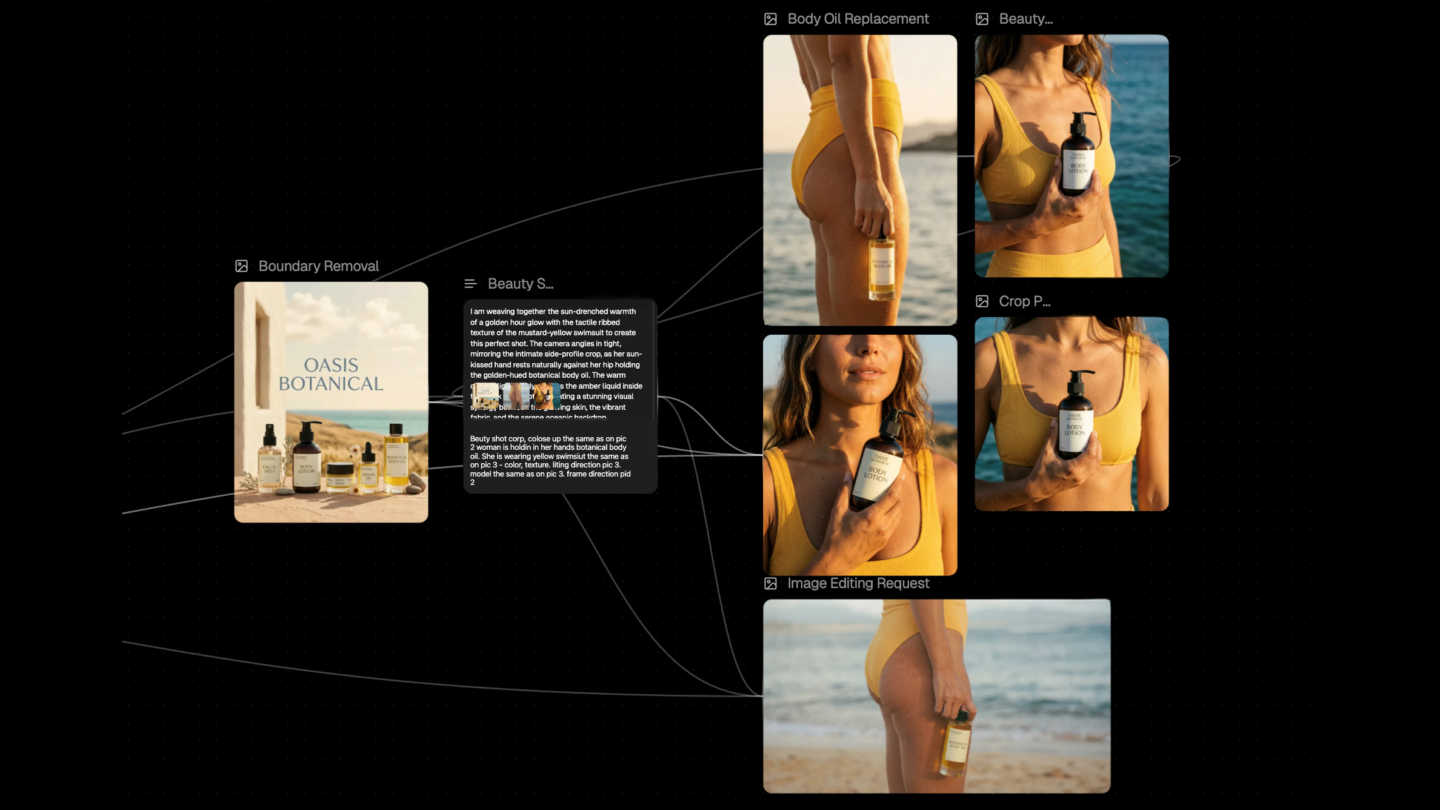
- Hybridization: We combine traditional photography (the real product, bottle, or piece of jewelry) with generative scenography. This preserves the physical authenticity of the object while optimizing the cost of building sets or shooting in distant locations.
- Pre-visualization: AI at the moodboard stage lets us “see” the lighting and framing before we even step into the studio. As a result, the shoot itself eliminates guesswork and lets us focus on emotion rather than technical fixes.
- Full immersion: We reserve this for surreal worlds that simply can’t be built physically in a studio, mainly for financial reasons. Here, AI is the only way to bring an idea to life without compromise.
When does budget optimization hit a glass ceiling?
The pressure to save is understandable, but professionalism lies in knowing where to draw the line. WGSN reports clearly point to the trend of “the renaissance of real.” In a world saturated with flawless digital faces, a subtle imperfection becomes a mark of quality.
If technology starts smoothing your brand’s identity down to the level of stock imagery – it’s time to return to craft. Your target audience pays for uniqueness, not a mathematical average. Wherever emotional depth matters, we’ll always bet on human craftsmanship.
Your quick audit: AI or craft?
Before you approve the budget for your next campaign, run through these points:
- Does it build your brand DNA? If you’re creating hero content meant to last for years – go with craft, supported by technology.
- Do you need scale? If you need to generate dozens of formats for different markets – this is where AI wins on efficiency.
- Does light matter? In the beauty category (textures, the physics of materials), the human eye and lens still have no competition.
- Who’s holding the wheel? Make sure the process is overseen by an experienced art director, not just someone operating a tool. The final result needs to tell your story, not the algorithm’s.
The magic of branding isn’t math
The brands that will win are the ones that can draw a clear line between efficiency and the magic of branding. True luxury in 2026 means craft supported by technology – not technology pretending to be craft. We help manage that balance, translating what technology can do into measurable gains for your brand’s positioning and budget.